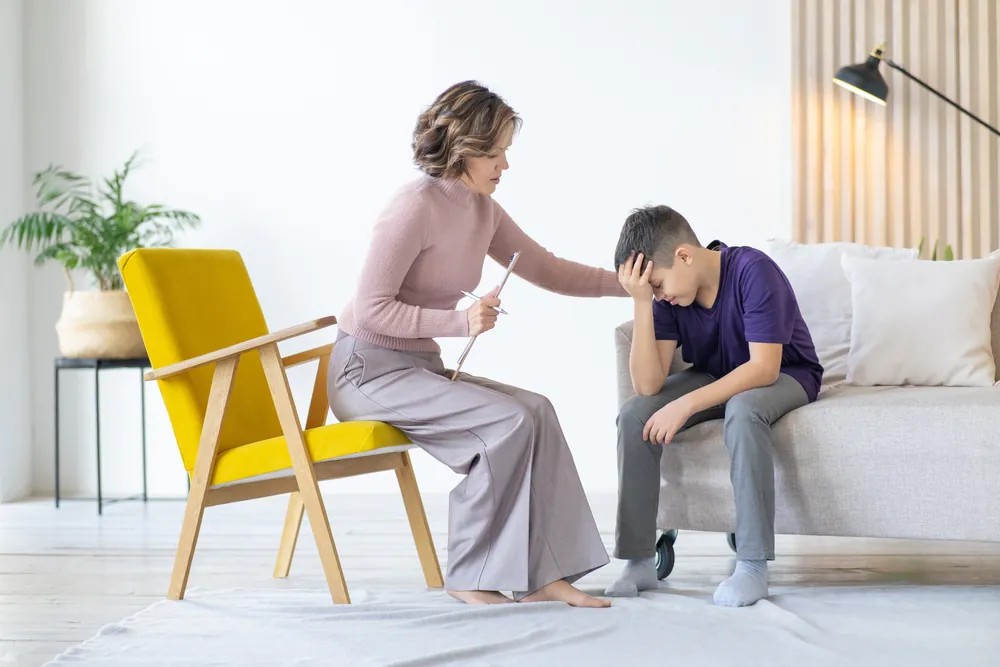
If a clinician has suggested DBT for your teenager, it usually means something specific: the difficulty is less about a single symptom and more about the intensity of their emotional responses and what they do in the middle of them.
DBT is one of the better-evidenced approaches for that pattern in adolescents. Here is what it involves and how the teen version differs from the adult one.
DBT for teens: the short version
Dialectical behavior therapy was developed for people whose emotions run hotter, escalate faster, and take longer to come down than most. Rather than treating that as a character problem, it treats it as a skills problem — the intensity is real, and what is missing is a reliable set of tools for the moments it peaks.
The "dialectical" part names its central tension, which is also its most useful idea: you are doing the best you can, and you need to do better. Both at once. For teenagers who experience most feedback as an accusation, holding both halves is often the thing that makes the treatment tolerable.
DBT organises around four skill areas — mindfulness, distress tolerance, emotion regulation, and interpersonal effectiveness. We cover those in detail in the 4 core DBT skills explained, so this piece stays on the adolescent adaptation.
What is different for teens
Parents are in it
The most significant difference. Adolescent DBT normally includes caregivers, on the reasoning that a teenager practising new skills inside an unchanged household will struggle to keep them. Parents learn the same vocabulary, which means "I'm using a distress tolerance skill" becomes a sentence everyone in the house understands.
An extra dilemma set
The teen adaptation adds material on the specific binds of adolescence — how much independence to grant, when to hold a line and when to bend, and how families oscillate between being too strict and too permissive rather than landing anywhere stable.
Shorter, more concrete
Skills are taught with examples from school, friendships, and phones rather than in the abstract, and the language is plainer.
Coaching between sessions
Many programmes include some form of between-session contact for the moment a skill is actually needed, on the principle that skills are learned in the situation rather than recalled from a worksheet a week later.
Which teens it suits
DBT is usually considered when a teenager shows several of:
- Emotional reactions that are intense, fast, and slow to settle
- Self-harm, or urges toward it
- Impulsive behaviour during distress
- Volatile relationships — very close, then abruptly cut off
- Chronic feelings of emptiness or an unstable sense of self
- Frequent, explosive conflict at home
If your teen is self-harming or has talked about not wanting to be here, treat that as urgent regardless of what treatment is eventually chosen. In the US you can call or text 988 at any time, and an emergency department is the right destination if there is immediate danger.
Which teens it does not suit
DBT is demanding — it involves homework, practice, and tracking. For a teenager whose main difficulty is a specific phobia, a single traumatic event, ordinary exam anxiety, or low mood without the volatility, a more targeted approach is usually a better use of their effort. For trauma specifically, EMDR is often more appropriate. It also asks real commitment from parents, and a programme entered reluctantly by everyone rarely produces much.
What it looks like week to week
A full DBT programme traditionally has several components — individual therapy, a skills group, between-session coaching, and a consultation team for the clinicians. Many practices deliver DBT-informed individual therapy instead: the same skills and framework in one-to-one sessions, without a group.
That distinction is worth asking about directly, because both are commonly described as "DBT" and they are different commitments. Ask whether a group is included, whether parents attend, and how long the programme runs.
We provide DBT-informed individual therapy rather than a full group-based programme — see DBT therapy in Miami and signs you might benefit from DBT. Where a teenager needs a full adherent programme with a skills group, we would tell you that and help you find one.
How to raise it with your teen
"You need DBT" lands badly. A few framings work better.
Lead with the feeling, not the diagnosis. "I've noticed things hit you really hard and take a long time to settle, and I don't think that's your fault — I think there are skills for it" is a description most teens recognise and few argue with.
Name the acceptance half. DBT's central premise — that they are doing their best and can build better tools — is unusually reassuring to a teenager who expects to be blamed. Say it plainly.
Be honest that you are part of it. Telling them you will be learning the same skills reframes it from "you are the broken one" to something the household is doing. This is often the sentence that changes the answer.
Give them some control. A say in the clinician, or agreeing to try a set number of sessions and then review, gets far better engagement than an open-ended requirement.
Do not oversell it. DBT involves homework and practice. A teenager told it will be easy and finding otherwise tends to disengage in week three.
What parents can do
- Validate before problem-solving. The single most useful skill for parents. "That sounds genuinely awful" first; solutions later, if invited. Skipping to the fix reads as dismissal and reliably escalates.
- Learn the vocabulary your teen is learning, so the skills have a shared language at home.
- Expect non-linear progress. Setbacks are part of the model rather than evidence of failure.
- Notice your own escalation. Households tend to co-regulate; a parent who stays steady is doing active treatment work.
Getting started
We see teens ages 13 to 17 in Miami and by telehealth across Florida. Individual counseling for your teen can be billed to insurance — Aetna, Oscar, UnitedHealthcare, Oxford, Avmed, Cigna, UMR, Student Resources — with benefits verified before scheduling; family sessions are self-pay at $130. Details in teen therapy and insurance in Miami.
Start with a free 15-minute consultation — contact us or call (786) 224-7111. See also teen counseling.
Frequently Asked Questions
What is DBT and how is it different from CBT?
Both are structured and skills-based, but CBT concentrates on identifying and changing unhelpful thoughts, while DBT focuses on tolerating and regulating intense emotion, and pairs acceptance with change rather than treating them as alternatives.
Is DBT only for teens who self-harm?
No, though it is well established for that. It is used more broadly where emotions are intense and fast-escalating, where behaviour becomes impulsive during distress, and where relationships and conflict at home are volatile.
Do parents have to take part?
In adolescent DBT, usually yes, and that is one of its main adaptations. The reasoning is that a teenager practising new skills in an unchanged household has a much harder time keeping them.
How long does DBT for teens take?
It varies by programme and by whether it is a full group-based model or DBT-informed individual therapy. Ask directly how long the course runs, whether a skills group is included, and what is expected of parents.
Do you offer full DBT programmes?
We provide DBT-informed individual therapy rather than a full group-based programme. If a teenager needs a fully adherent programme with a skills group, we will say so and help you find one.
My teen is self-harming — what should I do right now?
Treat it as urgent. In the US you can call or text 988 at any time, and an emergency department is the right destination if there is immediate danger. Arrange a clinical assessment promptly rather than waiting to choose a treatment model.